Monday, 6 May 2019

Where In The World Is 007?

One of the most important facets of the Bond Formula is international glamour.  007 doesn't pootle round boring old England; he doesn't spend the whole film in LA's dull suburbs like every other action film.  He jets across the world, skipping from continent to continent, filling his passports with stamps.  Bond comes from an era when just using an aeroplane was considered incredibly exciting.

This raises a conundrum for the filmmakers.  How do you show that Bond is now in a new country?  How do you convey that shift of location to the audience?  You could just whack a caption onscreen, but for a long time they tried to be a bit more imaginative.

At first, the filmmakers bought into that Sexy Air Travel mythos and used the airport itself.  Both Dr No and From Russia With Love feature air traffic controllers passing on the information that a plane has just landed in "Kingston, Jamaica" or "Istanbul", saving the audience from having to work it out themselves.  The filmmakers then have Our Hero stride manfully through the airport because yes, it's just that thrilling.


From Russia With Love introduced a second method for the audience: the really, really famous landmark.  In this case, it was St Mark's Square in Venice:


Goldfinger also features the airport method, with a tannoy announcement about the British United Air Ferries flight to Geneva, but it adds in a third informational tool - the really bloody obvious sign.

For a few films, that was enough.  Thunderball has a really, really famous landmark:


You Only Live Twice has a bloody obvious sign:


On Her Majesty's Secret Service has a slightly less famous landmark for its scenes in Portugal, with the Ponte 25 de Abril bridge and the statue of Christ:


And in the absence of really famous Swiss landmarks, it just goes to town with everything else Swiss (snow!  Skiing!  Bobsleigh!  Cable cars!  Cow bells!  Ice rinks!  St Bernards!)


The start of Diamonds Are Forever takes the local colour angle for its rapid fire start.  We get two locations, very fast, in the first few minutes, and they have to do it fast.  So Tokyo is plinky music and a paper screen and a charming floral arrangement:


Couldn't be more Japanese if it tried.  And though we get dialogue saying "Cairo!", could it have been more obvious once we saw a large man in a fez in a casino?


They then doubled up on the location cliches, with not only shots of the Amsterdam canals, but also a voiceover explaining you were in Amsterdam and by the way here's a really famous bridge.


Live and Let Die presented a problem.  Its pre-title sequence didn't just cut between three different locations, all without the friendly face of Bond to carry us there.  It also had to introduce a location that was entirely fictional - Dr Kananga's home of San Monique.  Finally, after eleven years, they caved and introduced captions.  New York and New Orleans are shown...


...and then we get our fake location, complete with explanatory text.


Having broken their duck with the captions, the filmmakers still resisted making them part and parcel of the Bond experience.  In The Man With The Golden Gun, they returned to bloody obvious signage:


...and helpful voiceovers explaining Bond was about to arrive in Hong Kong (by hydrofoil this time, because aeroplanes are no longer exciting).  There was a single caption in the follow up film, The Spy Who Loved Me:


A sub-rule was now established: captions were fine, so long as there was nobody familiar around to explain the location.  Since 007 hadn't appeared in the film yet, a Moscow caption was perfectly acceptable.  (By the way, what a great font that is).  When the exact same shot reappeared in For Your Eyes Only, there was no need for the caption, because it was followed by our old friends General Gogol and Rubelvich so we knew we were in Russia.


Moonraker stuck to a combination of famous locations - there's St Mark's Square again:


...and Bond getting off a Concorde in Rio before being driven past every famous sight in the city.  For Your Eyes Only largely moved between Greek Islands, so there was a bit of dialogue, but nothing really to catch your eye.

However, anxiety was setting in.  Someone had developed a taste for captions.  So while Octopussy's first shot after the titles was a close up of the Berlin Wall, they didn't trust the audience completely to join the dots, and a caption was added:


(I'm going to now complain, loudly and vociferously, that the onscreen captions are not always used on the DVDs, and sometimes they simply whack the closed captioning on there instead.  It is ugly and unacceptable).  Octopussy also laid a caption for the Kremlin Fine Art Repository, even though John Glen had filmed a big close up of the brass plaque.  Octopussy features our first piece of on-screen translated text: the legendary "GET OFF MY BED".  Fortunately they trusted the audience to work out that a huge shot of the Taj Mahal meant they were in India.


A View To A Kill returned to the well of famous landmarks - the Eiffel Tower for Paris, the Golden Gate Bridge for San Francisco...


...but it was clear this was proving to be far too much effort.  The Living Daylights broke out the captions for Bratislava, Czechoslovakia, and Tangier, as well as Rosika Miklos's "What kind of girl do you think I am?"


Licence To Kill opens with Michael G Wilson telling us we're in Florida...


...and then an entirely necessary caption because we were in a fictional country...


...but that was really the last time we'd be trusted in this way.  From GoldenEye onwards, captions became commonplace.  It's never made clear where Goldfinger's pre-title sequence is set; it could be any one of a dozen Latin American fleapits.  It's not important.  We get the gist.  GoldenEye, on the other hand, tells us there and then where we are:


We then got our first ever time caption, with "NINE YEARS LATER" appearing after the pre-credits.  Still, things got even worse come Tomorrow Never Dies:


That's not even a real place.  We got follow up captions for a ship:


...and an office building...


...and Wai Lin having a bit of a chat...


...and another ship...


A Bond film was starting to become a reading test.  Never mind the visual beauty, look at those captions!  The unofficial "only caption when Bond isn't there" rule went out the window too.


It continued with The World Is Not Enough...


and Die Another Day, though that was those ugly closed captions again so I've not done a screencap of those.  A new Bond in Casino Royale didn't mean a new style, and they continued with simply whacking a caption on up there to let you know where we were:


...unless it was St Mark's Square, because they probably figured out you'd already seen it enough in Bond movies so you didn't need a caption.


But the Bond people really lost their mind with Quantum of Solace.  Every single shift in location got a caption.  Every single one.  And not just a few words on screen either - MK12 really went to town and designed beautiful, location-appropriate cards for each one, in a different font every time.


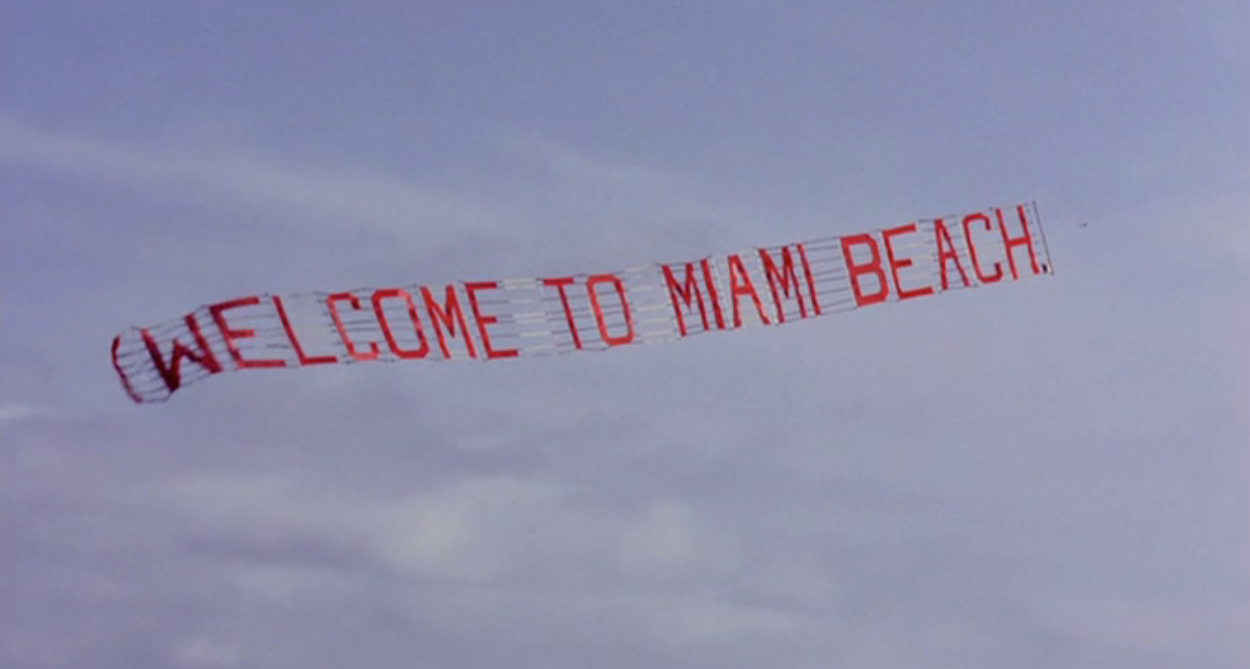
They were undoubtedly gorgeous but were they really necessary?  We need to know where 007 is, but not that much.  Context can tell us things.  M and Tanner were in amongst rainy concrete; obviously that's London.  There was a speedboat and a castle and a lake - it was beautiful, yes, but was there any need for us to get a caption telling us it was Talamone, Italy more than, say, where Marie was sunning herself in Diamonds are Forever?  It's as if the filmmakers now feel the need to spoonfeed us all the info.  And it's boring.  At least Welcome to Miami Beach trailing from the back of a plane was a bit glamorous.

This fear that we might stop caring if we don't know exactly where things are happening reached its logical conclusion in Spectre.


That's a shot of the Houses of Parliament, the London Eye, the River Thames, the South Bank... and they still stuck a caption saying London over the top of it.  Gee, do you think?

With any luck Bond 25 will be a bit more trusting.  Bit of sun and sand?  Jamaica.  Cheers.  Leaving everything else aside, they're going to Italy again.  By this point in time we can pretty much work out it's Italy again.  It always is. 

Monday, 11 December 2017

Wow, What A View!

There is an alchemy around Bond titles.  You hear a sequence of words and it sounds... Bond-y.  Ian Fleming managed to come up with a formula for his novels - largely continued by the films - where they sounded simultaneously sexy, violent, mysterious and glamorous. 

It's one thing to put these titles on a book.  For a film, you have to actually have human beings say it onscreen, and that's where it gets difficult.  They often aren't phrases you can casually drop into conversation and, as a result, the films have sometimes struggled to crowbar the title in.  This is a rundown of where the title of a Bond film appears in the film, ranked by how well it's done.  Is it natural?  Is it dramatic?  Is it significant to the plot?  Is it just really annoying?

Note on methodology: I've concentrated on the first time the title is spoken only, otherwise the entries on films named after characters or organisations would get silly.  Likewise, wherever possible I've gone with where the line is actually spoken, rather than an earlier appearance on files or boats or whatever.  The very first shot of Moonraker is a space shuttle with the name of the film written on the side, for example, but I'll disregard that for this list.

24.  Diamonds Are Forever

Somewhat unbelievably, even though Bond lists the features of a diamond ("they cut glass, suggest marriage, I suppose they've replaced a dog as a girl's best friend") he doesn't add "also, I believe Diamonds Are Forever."  It's a shocking oversight in a film where people are talking about diamonds in almost every scene, so this goes at the bottom.

23.  Quantum of Solace

QoS skipping mentioning the name is more forgivable, given that it's a title that takes quite a lot of explaining.  Calling the criminal organisation Quantum gives it a measly half-point.

22.  Tomorrow Never Dies

Similarly, TND features the word Tomorrow an awful lot, but the title never makes it to the screen.  I wonder if there was a Tomorrow Never Lies line that was cut?

21.  Live and Let Die


There's no actual reason for Live and Let Die to be called Live and Let Die.  It doesn't really have anything to do with the plot, and the dialogue from the novel explaining it never made it to the screen.  So we can only assume it's named after that snappy tune performed by BJ Arnau in the Fillet of Soul.

20.  The Spy Who Loved Me


The title is never said on screen, though Stromberg does say "a British agent in love with a Russian agent", which is more or less the same thing in a roundabout way.

19.  On Her Majesty's Secret Service


Another close but no cigar; Draco says that if he did have information on Blofeld "I wouldn't tell Her Majesty's Secret Service."  Four words out of five isn't bad.

18.  A View To A Kill


The original Fleming short story was called From A View To A Kill; without that first word, it doesn't really make sense.  That's no excuse for the absolute nonsense that Grace Jones and Christopher Walken are forced to spout.  "Wow," says May Day, with all the enthusiasm of a woman who's just discovered her birthday treat is a trip to the Mrs Brown's Boys Interactive Tribute Experience.  "What a view."  "To a kill," adds Zorin, in a line of dialogue that makes no sense on any level; not as part of the script, not as a scene within the film, not as something a real human being would ever say.  It is nonsense, but it is, indeed, the title of the film, so it has to rank higher than the ones before. 

17.  From Russia With Love


Another phrase that no person who wasn't in a film would use, this one isn't spoken, but is scrawled over a picture of Tania on the backlot on the Bosphorus ferry.  I'm ranking it higher than A View To A Kill even though it's not dialogue because it doesn't make you cringe, and also Sean Connery's handwriting is very nice.

16.  Casino Royale


The building gets a lot of beautiful shots later, but the first time anyone says Casino Royale is a very casual mention in a bit of dialogue about Le Chiffre.  There's no drama or import given to it; if you're not paying attention you could miss it altogether.

15.  Licence To Kill


"Your licence to kill is revoked" is a bit clunky and, as with Judi above, it's sort of thrown away.  If only there was an M who knew how to bring some gravitas to a film title.

14.  For Your Eyes Only


"For your eyes only, darling," says Melina in her usual fashion of sounding like she'd just been woken from a nap.  She's not a spy, so quite why she's tossing out secret service jargon like this I have no idea.

(It should be noted that there's a bit earlier in the film where a file with For Your Eyes Only on it gets a whacking great close up and a musical sting, which would have been perfectly sufficient before they decided to over-egg the pudding right at the end).


13.  The Living Daylights


"Whoever she was, I must've scared the living daylights out of her."  It's a perfectly adequate shoehorning in of the title, and it gets a nice zoom as it's being said, but it's just a bit dull.  Solid mid-table stuff.

12.  Die Another Day


It should be good.  There's a dramatic reveal of Bond wielding a pistol.  It leads directly into the explanation about Graves' secret identity.  But Brosnan sounds so bored.  It's like they couldn't decide what to call the film, so they made him sit there and recite a load of alternative lines ("I see you're beyond the ice, Colonel Moon").  "So you live to die another day," was at the end of the shoot, when he just wanted his dinner and a cup of tea.

11.  Goldfinger


"Auric Goldfinger.  Sounds like a French nail varnish."  I'm guessing Guy Hamilton was okay with this understated introduction of the film's title and villain, because he knew it would be immediately followed by Gert Frobe making his entrance looking like the most brilliant Bond villain you've ever seen.  The dialogue was incidental.

10.  GoldenEye


"We're going to test the GoldenEye," says Ourumov, in a way that is casual but also hints at its importance.  Whatever a GoldenEye is must be significant because we know that it's the name of the film, but it's said in a nicely underplayed manner.

9.  Moonraker


Bond enters M's office, fresh from showing off to Moneypenny about how great he is, and finds the Minister of Defence and Q in there as well.  From this he intuits that he's about to be sent off to investigate the current national crisis, so he says, "Moonraker, sir?"

8.  The Man With The Golden Gun


The location is the same as Moonraker; its position in the film - immediately after the titles - is also the same.  There are even two extra bodies in the office.  What puts TMWTGG above MR is that Bond isn't being a smug git in this one.  His "Scaramanga?  Ah yes - the man with the golden gun," comes because he's asked a question by M, not because he's the cleverest person in the room and wants to show it off.

7.  Spectre


I'm not going to get into how a woman who is estranged from her father knows more about the organisation he worked for than the world's intelligence agencies; suffice to say, it's nonsense.  I will say that Lea Seydoux says it in a very good way, pronouncing it so well it made it into the trailer.

6.  Skyfall


This one's an oddity, because it's said by someone off camera, and we don't understand what it means for another hour and a half.  But the fact that it causes 007's face to crack and collapse is fantastic, and draws you even further into the film.

5.  The World Is Not Enough


This one suffers because it's a little clunky - Elektra's sudden, dramatic "I could've given you the world!" seems to come out of nowhere - but both Brosnan's reading and its position within the film are excellent.  "The world is not enough," is both a motto and a statement of defiance.  Bonus points for laying the groundwork for this one in a film thirty years before too.

4.  Dr No


"What else do we know about this Chinese gentleman?"
"Nothing much... except his name.  DOCTOR NO."  Honestly, if there had been a sudden cymbal crash and a flash of lightning, it would have seemed entirely in keeping.  Jack Lord manages to say the villain's name with so much drama it could very easily slot into a Hammer Horror.

3.  Octopussy


Weirdly, the first mention of the film's title has nothing to do with the character it's named after.  Instead, it does what everyone had been saying from the moment it had been announced: makes a joke about vaginas.  "That's my little octopussy," says Magda, in a saucy way that could be talking about her tattoo, but also could be talking about her genitalia.  Textbook.

2.  Thunderball


Remember numbers 15 and 16, where Robert Brown and Judi Dench failed to bring any drama to the title?  They should've watched Thunderball to see how it's done by a proper M.  Bernard Lee gruffly announces "Codename: Thunderball" with authority, gravitas and absolute purpose; it works both within the scene, and also as a little reach out to the audience of "this is what that nonsensical word means."  Brilliantly done, and only slightly mangled by the cut to Bond's face.  We need a big close-up of M, dammit!

1.  You Only Live Twice


So.  We're inside a hollowed out volcano turned rocket silo.  James Bond just almost went into space.  A man pokes his head out and announces that he is Ernst. Stavro. Blofeld.  And he's Donald Pleasance.  And he looks like that.  Then, just to heighten it even further, they reference Bond's fake death right at the start, and 007 claims this is his second life. 

Right on cue: "You only live twice, Mister Bond."

Absolutely impeccable.